

Most return-to-office plans budget for desks, screens and better coffee. Few budget for quiet.
First came the phone booth. Offices filled up with narrow, soundproof boxes where you could step in, take a call and step out again. They were useful, but nobody wanted to spend an afternoon in one.
Now a bigger sibling is taking over: the work pod. It is a private, enclosed space for one person, with room for a proper desk and a full-size ergonomic task chair. Think of it less as a booth and more as a personal office that arrives in a box and can be set up in an afternoon, and moved with you if you move offices.
Here is why work pods are becoming one of the most requested items in office design, and what separates a good one from a glorified cupboard.
The open office forgot about focus
Open-plan offices were designed for collaboration. Take down the walls and ideas flow freely, or so the theory went. Floor plans got denser and cheaper to run.
What suffered most was deep work. Writing, analysis, coding, planning: anything that needs an hour of unbroken concentration is hard to do with conversations, calls and foot traffic all around you. Headphones help a little. Working from home helps more, which is exactly why many people now save their focus work for days away from the office.
Private offices used to solve this, but they have largely disappeared. They are expensive, inflexible and often sit empty. Work pods bring back the best part of the private office, a door you can close, without the cost of building one for everyone.
Phone booths solved calls. Work pods solve focus.
Hybrid work filled the calendar with video calls, and the phone booth became the quick answer. A booth is built for short stays: a small footprint, a stool or a perch and a narrow shelf. That is perfect for a 15-minute call and uncomfortable for anything longer.
The work pod is designed for the opposite use. It gives one person enough floor space for a real desk and a full-size task chair with wheels and armrests, plus room to stretch out, spread papers or set up a monitor. People can book it for a morning of focused work, not just a call.
That difference changes how offices use them. Booths absorb the noise of calls. Work pods give people a reason to bring their most important work into the office instead of saving it for a day at home.
Why not just build private offices?
Building even a small office means construction: walls, ceilings, electrics, ventilation, fire safety and often landlord approval. It is slow, messy and permanent. Work pods sidestep almost all of that.
Speed. A pod arrives in modules and is assembled in hours, not weeks, with no dust or downtime for the people around it.
Flexibility. Pods can be moved when teams grow, shrink or reorganise. Some roll on hidden casters, so they can be repositioned without dismantling.
Shared use. A built office usually belongs to one person and sits empty when they are out. A pod is bookable by anyone, so it earns its floor space every day.
Leases. Pods are furniture, not fit-out. When the company moves, the pods move too.
For companies unsure how much office they will need in three years, that flexibility is often the deciding factor.
What makes a work pod worth sitting in all morning
A phone booth only has to be bearable for a few minutes. A work pod has to be genuinely comfortable for hours. That raises the bar on almost everything.
Space for proper furniture. Enough floor area for a full-size task chair to roll and swivel, and a desk deep enough for a laptop and a monitor. A height-adjustable desk lets people switch between sitting and standing.
Fresh air. Ventilation is the make-or-break feature for long stays. Look for quiet, continuous air exchange with adjustable airflow and a boost mode.
Lighting. Dimmable, glare-free light with preset modes for focus and for calls, plus optional face lights for video.
Acoustics. Certified sound reduction (Class A under ISO 23351-1 is the top rating) keeps the office out and your work in. Good absorption inside stops it feeling like a sealed box.
Power and connectivity. Sockets and USB within reach of the desk, a screen mount, and a network point for anyone who needs a wired connection.
A sense of space. Generous glazing and a light interior make a one-person room feel open rather than cramped.
An occupancy light on the roof is a small touch that makes a big difference: colleagues can see at a glance whether the pod is free.
Built to last, not to landfill
Sustainability has become a real buying criterion. Building walls and tearing them out again every few years generates a lot of waste. A well-made pod can stay in service far longer, moving from floor to floor and office to office.
The newest generation of pods takes this further with swappable panels and modular parts. Exterior colours and interior fabrics can be changed to match a refresh of the office. Furniture can be replaced, and accessories like screen brackets or extra power can be retrofitted later. Manufacturers increasingly talk about designing pods for decades of use and high recyclability at end of life.
For companies reporting on their environmental impact, that circular approach is a meaningful advantage over traditional fit-out.
Phone booth or work pod?
Most offices benefit from both, because they do different jobs.
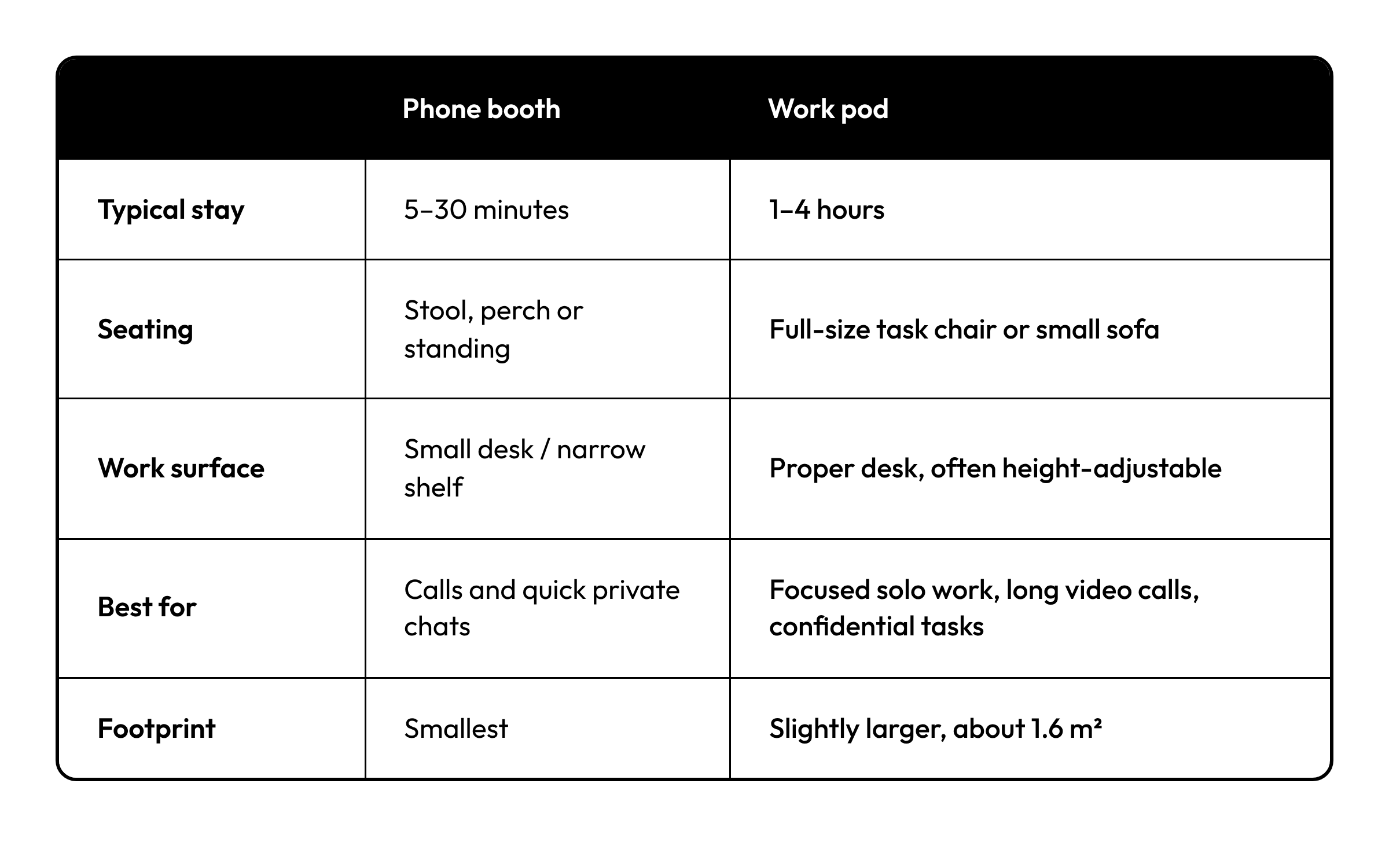
A useful rule of thumb: if people are taking calls in stairwells, add booths. If they are staying home to get serious work done, add work pods.
The private office, reinvented
Work pods started as an upgrade to the phone booth. They have become something more useful: a flexible, shared private office that any company can add without building a single wall.
As offices compete with the home for people's best working hours, quiet and comfortable focus space is no longer a perk. It is one of the strongest reasons to come in at all.
If your people say they cannot concentrate at the office, a work pod might be the simplest fix you have not tried yet.
