
There’s a persistent assumption in commercial interiors that reconditioned means compromise. That choosing reclaimed carpet tiles is a sustainability gesture that comes at an aesthetic cost — that somewhere in the deal you’re accepting something slightly worn, slightly off-colour, or slightly not-quite-right.
It’s an understandable assumption. And it’s wrong.
At Welltek Group, we operate one of the UK’s most active carpet tile reconditioning programmes, processing used tiles through Europe’s only water-tunnel cleaning system and returning them to the market in what we’d describe — without exaggeration — as like-new condition. We’ve seen the before. We’ve seen the after. The gap between them consistently surprises people who haven’t witnessed the process first-hand.
This post is our attempt to close that gap — to explain exactly what happens to a used carpet tile between collection and reinstallation, address the myths head-on, and show what reconditioned carpet tiles actually look like in a real commercial project.
The myth, examined
The scepticism about reclaimed carpet tiles tends to cluster around a few specific concerns. Let’s take them one by one.
“They’ll still look worn.”
The most common objection, and the one most directly addressed by the reconditioning process. The deterioration people associate with used carpet tiles — matted pile, discolouration, embedded dirt — is almost entirely reversible with the right cleaning technology. The key word is embedded. Surface-level dirt is easy. The question is what’s been ground in over years of foot traffic, and what’s happened structurally to the pile itself.
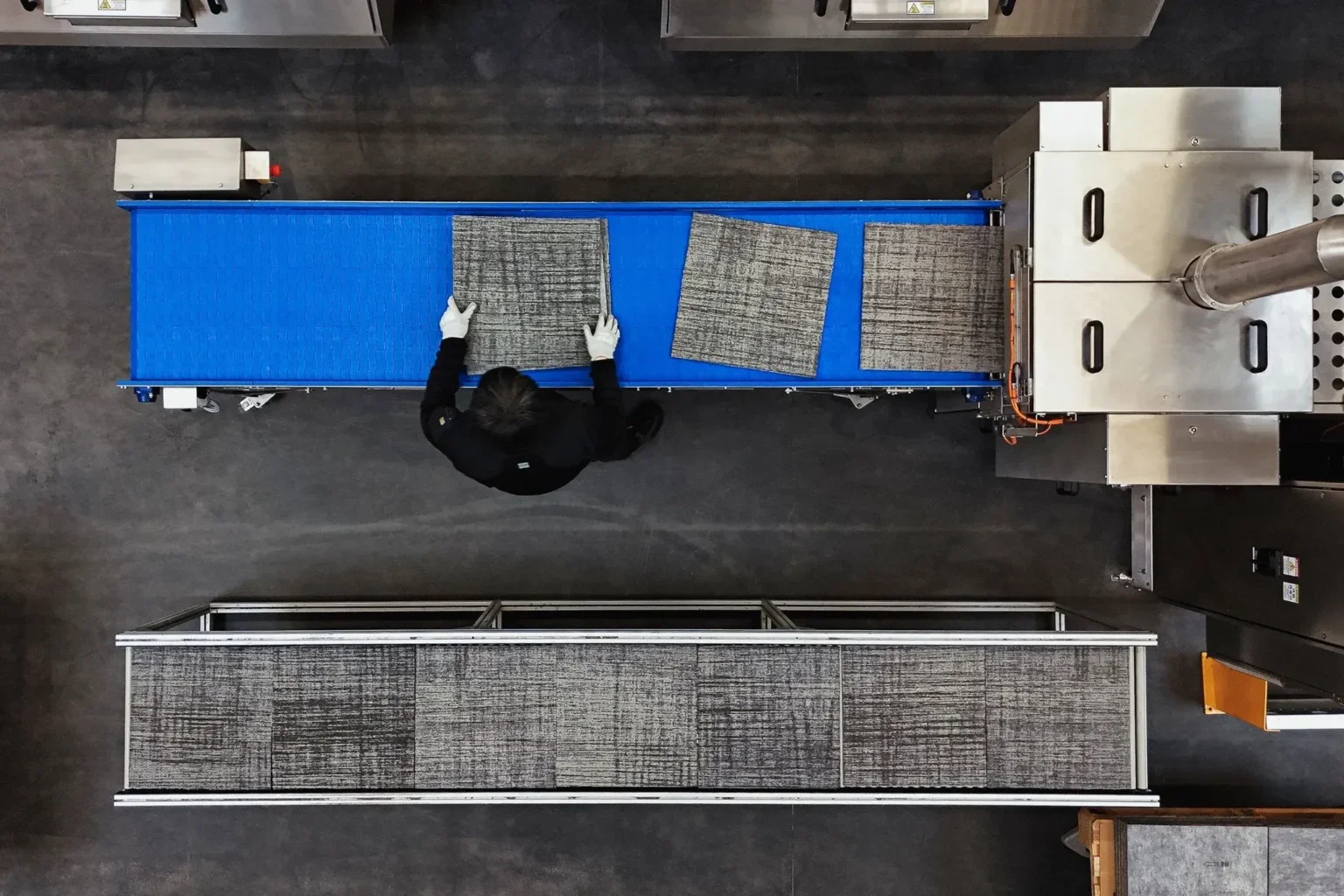
The water-tunnel system used by Encore by Design (Welltek’s specialist carpet tile reconditioning partner) doesn’t just clean the surface. It reaches embedded dirt, stains, and allergens that conventional cleaning methods never touch. The process also addresses indentations from furniture legs, partition bases, and floor-standing equipment — one of the tell-tale signs of previous use that visual inspection alone cannot reverse. The result is a tile that isn’t just superficially clean, but structurally restored.
“You won’t be able to match patterns or colours across a large floor area.”
This is a more legitimate concern, and it’s where the quality of the supplier matters enormously. Welltek holds large quantities of popular brands — including Milliken, Interface, and Shaw — allowing us to supply consistent batches from the same product line. Every tile that enters our stock has been inspected by our experienced team and must meet our quality standard before it goes anywhere near a marketplace listing. Tiles that don’t pass are not reconditioned and sold; they’re diverted differently.
For a project requiring several hundred square metres of a single colourway, this matters. Consistency across a floor isn’t just aesthetic — it’s professional credibility. Our stock depth and batch management make it achievable.
“Reconditioned tiles are only suitable for back-of-house or secondary spaces.”
The Sheldon Square project — which we’ll come to shortly — disposes of this myth more definitively than any amount of copy could. Premium-grade reconditioned Milliken carpet tiles, installed in a British Land commercial development, in spaces that are anything but secondary. The tiles were reconditioned by Encore by Design, installed by professional flooring contractors, and photographed for a project case study that neither the developer nor the contractor would have wanted associated with anything that looked substandard.
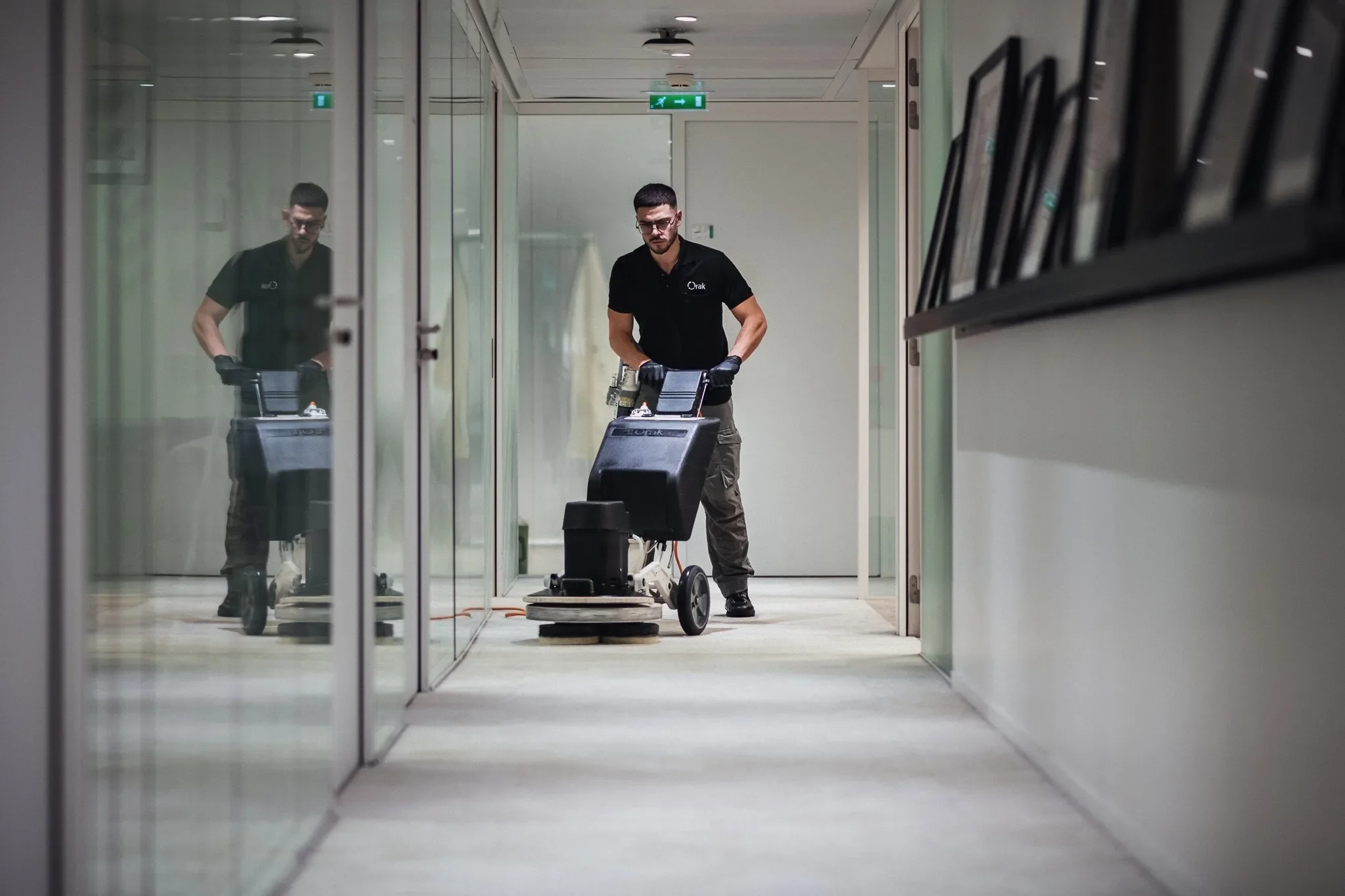
What cctually happens: the reconditioning process
Understanding why reconditioned tiles can look as good as new requires understanding what actually happens to them. Here’s the process from collection to reinstallation.
Step 1: Collection and Initial Assessment
Carpet tiles are uplifted from the outgoing site according to a strict handling protocol. Only full 50×50cm tiles are accepted — off-cuts and partial tiles cannot be processed. Tiles are stacked flat onto pallets, pile facing up, in consistent rows, with a maximum load of 180–200 sqm per pallet. Cardboard edge protectors and stretch film protect them during transit.
This handling stage matters more than most people realise. A tile that arrives damaged from poor uplift is a tile that cannot be reconditioned. The protocol exists to protect the asset throughout the chain.
Step 2: Expert Inspection
On arrival, every tile is assessed by an experienced team. Tiles that are too far gone — structurally damaged, beyond restoration, or unlikely to meet our quality standard post-cleaning — are identified and removed from the reconditioned stream. This is the checkpoint that makes the quality guarantee meaningful. We don’t recondition everything and hope for the best; we select what can genuinely be restored.
On average, 40–50% of uplifted carpet tiles can be successfully reconditioned and diverted from landfill. The rest are handled responsibly but don’t enter the reconditioned tile supply.
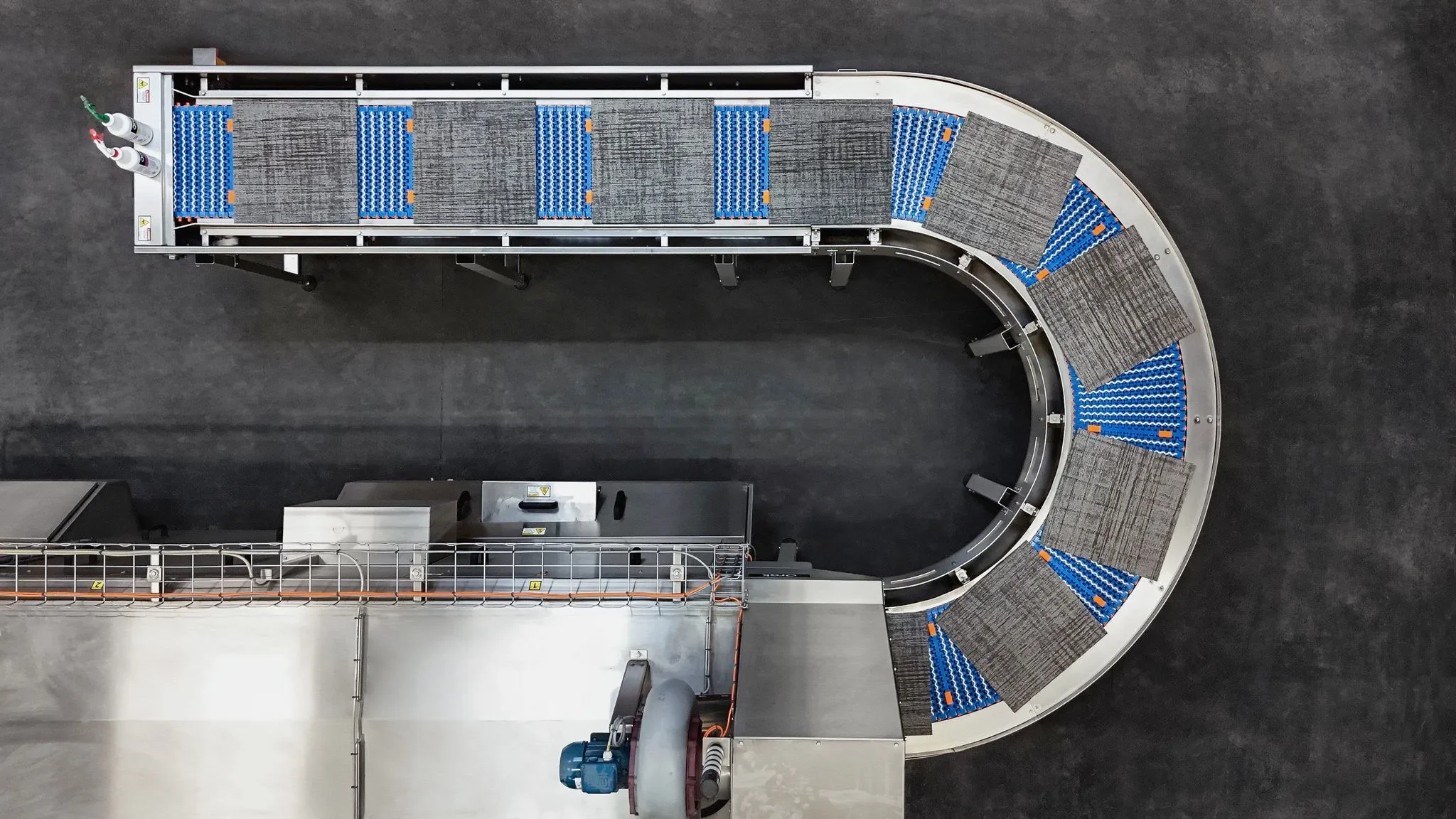
Step 3: The Water-Tunnel Cleaning System
This is where the transformation happens. Europe’s only water-tunnel cleaning system for carpet tiles — a purpose-built process capable of handling 80–100 square metres per hour.
The system addresses what conventional cleaning cannot. Embedded dirt and stains from years of foot traffic are removed. Allergens that have settled deep into the pile are extracted. And critically, the indentations caused by furniture legs, partitions, and heavy equipment — the physical compression of the pile that signals previous use — are reversed. The pile is restored to its original structure, not just cleaned on the surface.
No spray-and-wipe. No industrial vacuum. A proprietary deep-cleaning process that treats the tile as what it is: a recoverable asset.
Step 4: Quality Control and Stock Management
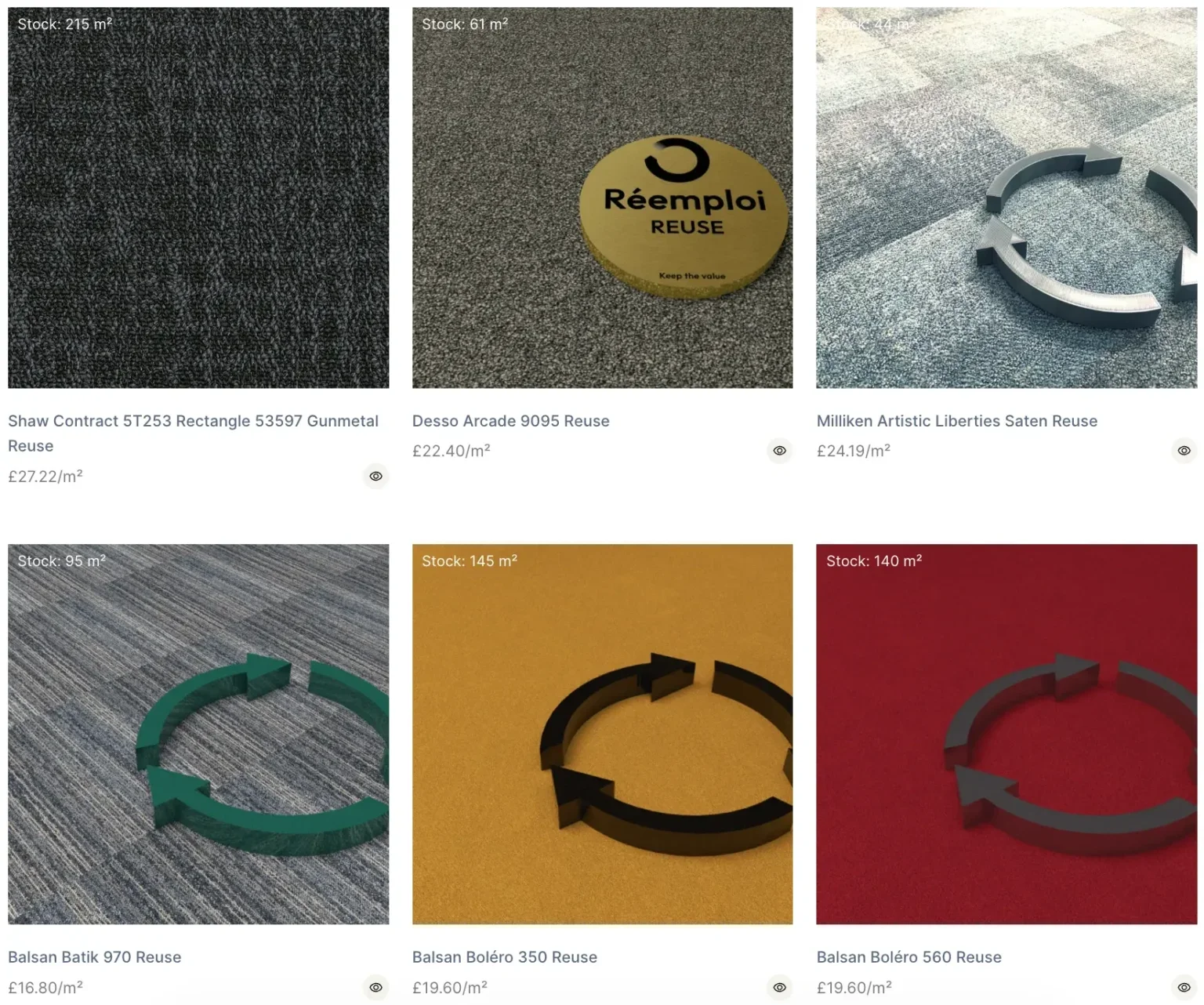
Post-cleaning tiles are inspected again before entering the marketplace. Tiles are catalogued by brand, colourway, and batch to allow consistent specification at scale. The live marketplace at encorebydesign.co.uk allows buyers to see what’s in stock, in what volumes, before they commit to a specification.
Step 5: Reinstallation
Reconditioned tiles are reinstalled using exactly the same methods as new tiles. At Sheldon Square, MagTabs — reversible adhesive-free fixings — were used to install the reconditioned Milliken tiles, meaning they’re already positioned for their next uplift and reconditioning cycle. Circular by design, not just by intention.
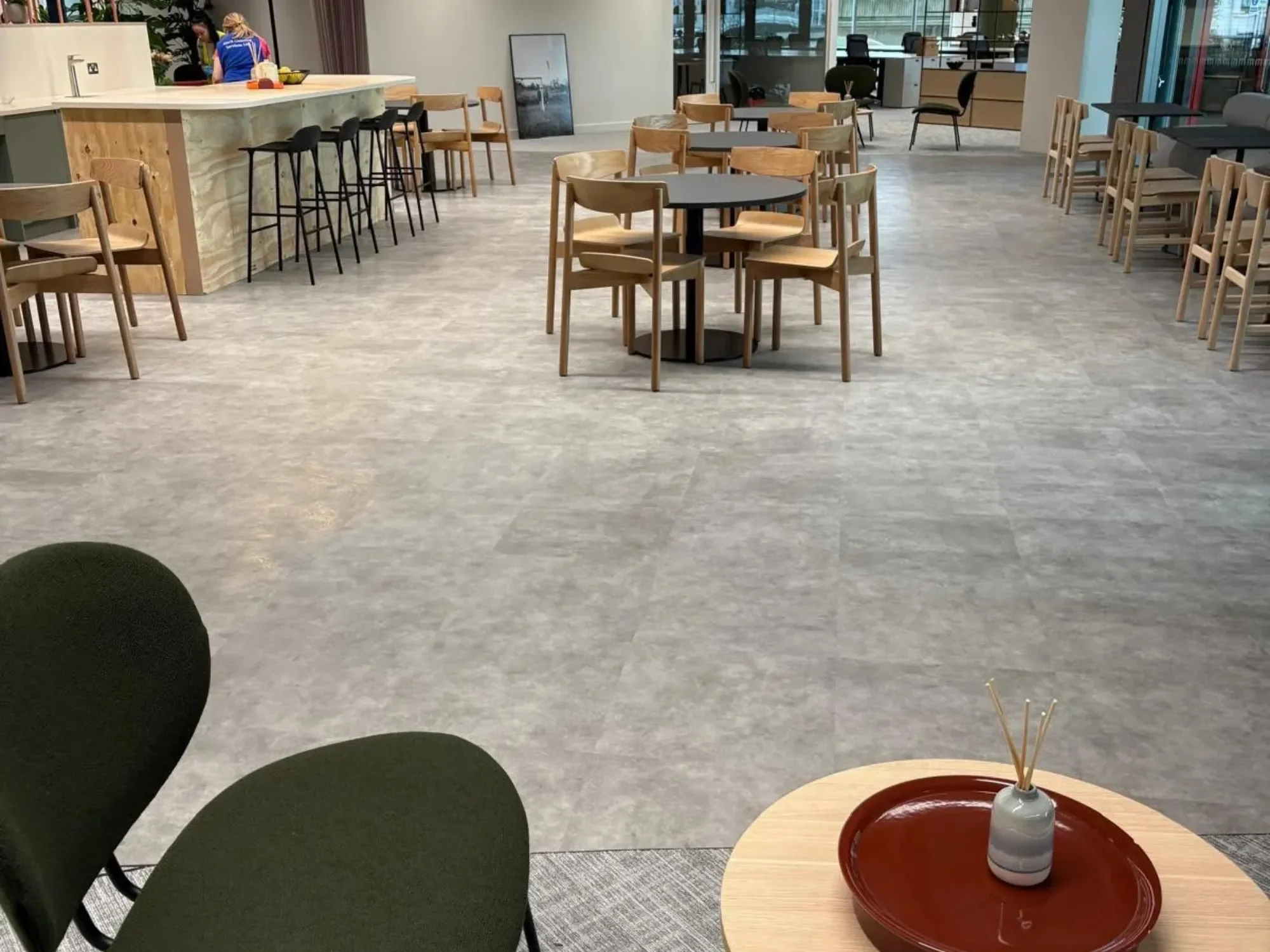
Real project: Sheldon square, British land
Abstract claims about quality are easier to make than to substantiate. So here is a project where the chain of custody is fully documented and the parties involved — developer, design-and-build contractor, flooring contractor — are all named.
Developer: British Land
Design & Build: Thirdway
Flooring Contractor: Explore Tiling & Flooring
Reconditioning: Encore by Design
British Land’s sustainability credentials are well established. Their work across the Kingdom Street project established reversible flooring fixings as part of their recommended sustainability brief for office fit-outs. Sheldon Square followed the same logic.
Approximately 3,000 sqm of reconditioned Milliken carpet tiles — refurbished by Encore by Design — were installed across the development using MagTabs from Circular Building Solutions. The access floor beneath them was professionally cleaned and prepared for its next life, with the reversible fixings ensuring that when the time comes for the next fit-out, the tiles can be lifted cleanly, reconditioned again, and redeployed.
The result is a commercial floor finish in a premium London development that meets British Land’s sustainability requirements, installs identically to new tiles, and carries the same visual quality expectation that any developer of that calibre would require.
That is the answer to the question in this headline.
The carbon numbers
For organisations with active ESG office procurement commitments, net zero office interiors targets, or carbon footprint office refurbishment requirements, the environmental case for reconditioned carpet tiles is compelling and quantifiable.
Producing a new carpet tile carries significant embodied carbon. Manufacturing the nylon pile, the bitumen or PVC backing, and the adhesive compounds required for installation adds up. When a tile ends up in landfill after a single fit-out cycle — as the majority still do — that embodied carbon is entirely wasted.
Reconditioning and reusing a carpet tile avoids most of that. The estimated saving is approximately 8kg of CO₂ per square metre of reused carpet installed. For a modest 500 sqm office floor, that’s 4 tonnes of CO₂ avoided. For a 3,000 sqm installation like Sheldon Square, the figure approaches 24 tonnes — before considering any other sustainability interventions in the same project.
For organisations building sustainable commercial interiors and measuring their carbon footprint against BREEAM, SKA, or internal net zero targets, that is a meaningful, reportable number, achieved without sacrificing quality or design intent.
This is what genuine circular economy office furniture and flooring looks like in practice: not a compromise, but a quantifiably better decision.
Design versatility: what’s available
The practical question that follows the quality question is usually about design range. If I’m specifying reconditioned tiles, what am I actually choosing from?
The honest answer is that availability varies, and the best results come from working with a supplier who holds sufficient stock depth to support your project’s requirements. Welltek and Encore by Design stock large volumes of tiles from Milliken, Interface, and Shaw — three of the most widely specified commercial carpet tile brands in the UK — across a range of colourways and patterns.
For sustainable office fit-out UK projects, this range covers the vast majority of standard commercial interiors briefs. Milliken’s design portfolio alone spans everything from subtle corporate textures to expressive geometric patterns. Interface’s work across their modular tile range includes designs specifically conceived for biophilic office design UK schemes. Shaw’s commercial range covers high-traffic environments with the pile density to withstand sustained use.
The practical tip for specifiers: engage Welltek early. If you have a specific colourway or pattern family in mind, we can check current stock volumes and advise on batch availability before you commit to a specification. Treating reconditioned tiles as an afterthought — something to explore after the design intent has already been set — is the most common way for the process to become frustrating. Involving us at brief stage opens up more possibilities, not fewer.
The take-back scheme: closing the loop from your project
Welltek’s second life programme works in both directions. We supply reconditioned tiles to new projects, and we collect end-of-life tiles from office refurbishments, fit-outs, and clearances, processing them through the reconditioning cycle for the next user.
If you’re managing a carpet tile removal service requirement — a site clearance, a lease-end fit-out strip-out, or a refurbishment — the take-back scheme offers both a practical and financial solution. We facilitate ethical clearances and offer a cashback for uplifted tiles that meet our acceptance criteria.
The process is straightforward:
Provide 72 hours’ minimum collection notice with site address, postcode, any access restrictions, and pallet count
Stack full 50×50cm tiles flat onto standard pallets, pile facing up, in consistent rows
Maximum 180–200 sqm per pallet, with cardboard edge protectors on all four sides and stretch film wrap
This is a carpet tile buyback scheme that turns a disposal liability into both a financial return and a measurable contribution to your project’s sustainability reporting. For fit-out contractors, this is a straightforward way to divert material from landfill with minimal process overhead. For end clients, it’s evidence — with numbers attached — of circular economy office furniture practice in action.
Who is this for?
Fit-out contractors and main contractors managing strip-outs and refurbishments who need a compliant, cost-effective disposal route for uplifted carpet tiles, and who want a verified reconditioned tile supply for the next project.
Interior designers and workplace consultants working on sustainable office fit-out UK briefs who want to specify reconditioned tiles with confidence in the quality, consistency, and documentation of what they’re sourcing.
Property developers and occupiers with BREEAM, SKA, net zero, or internal ESG targets who want quantifiable, reportable material reuse built into their fit-out specification from day one.
Office managers and facilities teams handling lease-end clearances who want a responsible, financially sensible alternative to skip hire.
The short answer
Can reclaimed carpet tiles really look as good as new?
Yes — provided they’ve been through a proper reconditioning process with the right technology, inspected and selected by people who know the difference between a tile that’s recoverable and one that isn’t, stocked in sufficient volume to support consistent specification, and installed by contractors who treat them with the same care as any premium floor finish.
That’s exactly what Welltek’s second life carpet tile programme does. It’s what Encore by Design’s water-tunnel cleaning system makes possible. And it’s what British Land chose for Sheldon Square.
The before-and-after isn’t a marketing trick. It’s the output of a process that has been refined to do one thing exceptionally well: give carpet tiles a second life that’s indistinguishable from the first.
Next steps
Shop our live stock of reconditioned carpet tiles at encorebydesign.co.uk/shop — Milliken, Interface, Shaw, and more, in large quantities, inspected and ready to specify.
Arrange a carpet tile collection from your site via our take-back scheme at welltekgroup.co.uk/services/second-life-carpet-tile.
Book a showroom appointment to see samples and discuss your project at Welltek Group, 53 Little Britain, EC1A 7BH, or call 020 7336 0657.
Welltek Group operates the UK’s second life carpet tile programme in partnership with Encore by Design. We also supply Silen acoustic pods, remanufactured office chairs, and a furniture subscription service — all designed to reduce the embodied carbon of commercial interiors and support net zero workplace commitments across the UK and London.
